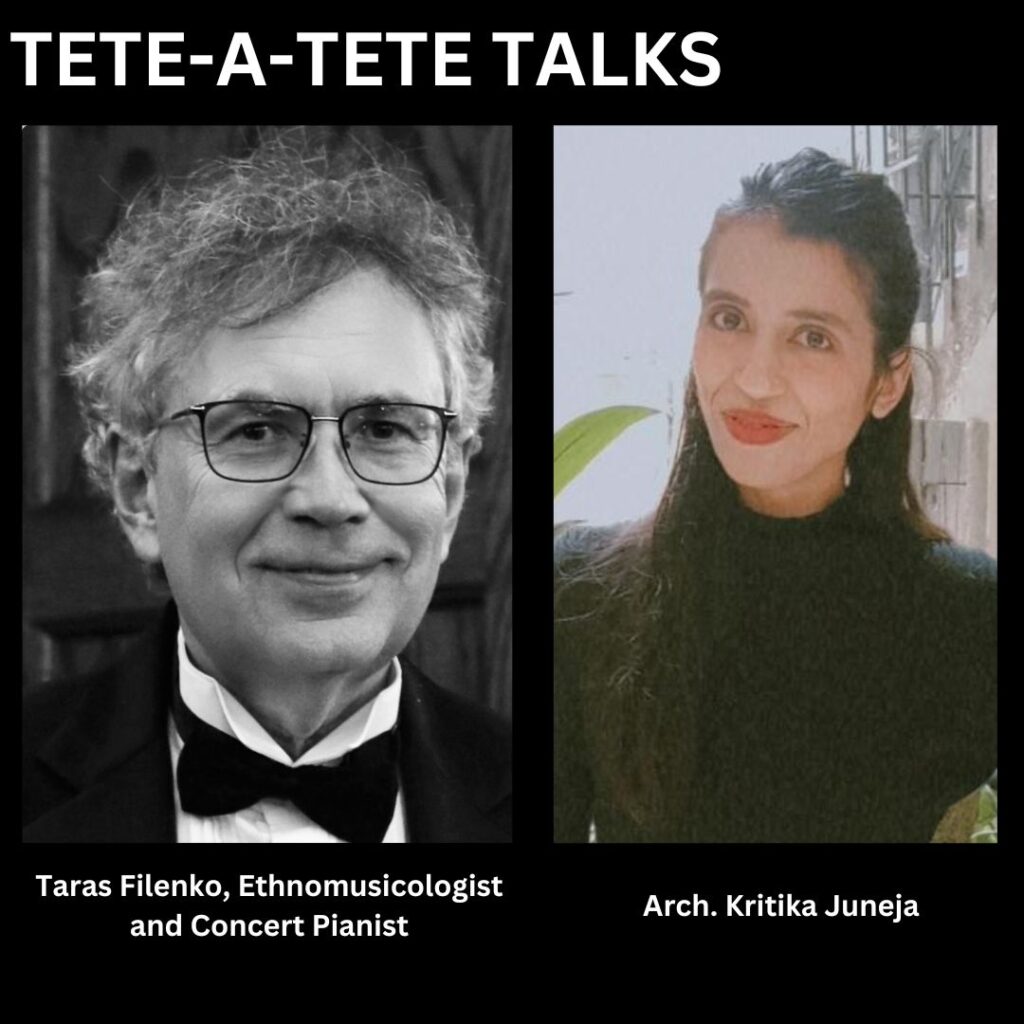
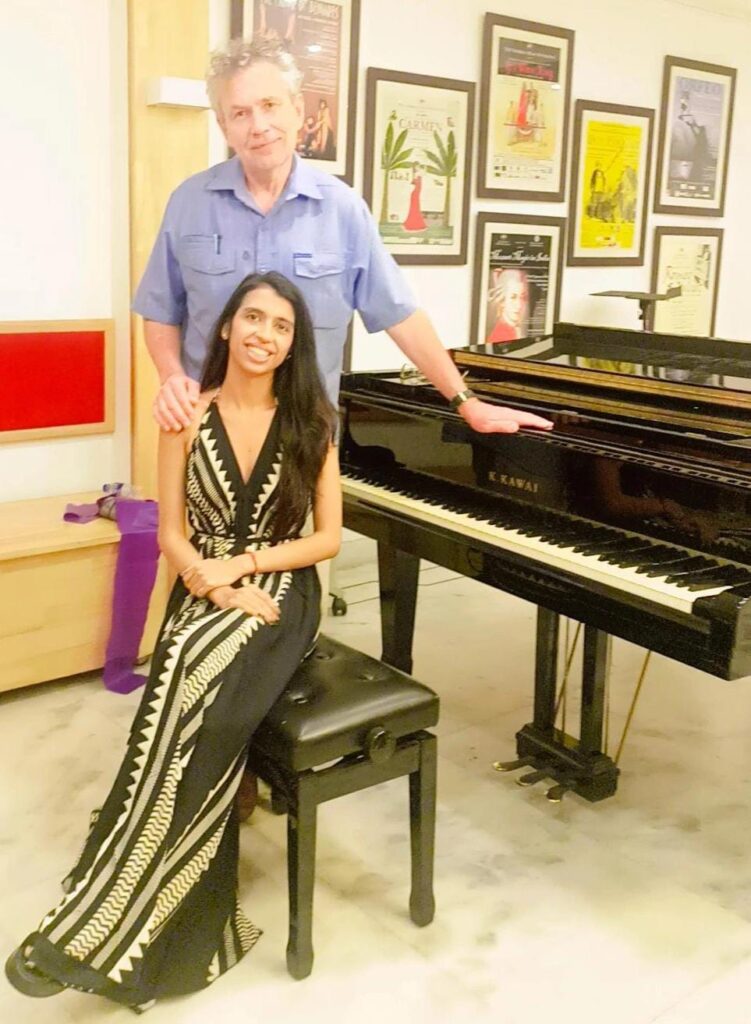
Ciao Everyone! We are pleased to welcome Dr.Taras Filenko, an ethnomusicologist and concert pianist, for our next episode of Tete-a-Tete series powered by ArchValor and hosted by none other than our wonderful host, Ar. Kritika Juneja.
KJ:-To begin with, could you tell us something about your early brush with music, culture, and art? What inspired you to get started with?
TF:-I initially planned to become an archaeologist and historian, not a musician. All of my friends at school had some sort of musical background, from theatre to drama, piano, and flute. My parents insisted that every intelligent person should speak English and play piano, violin, or cello. Music was my destiny. In addition, my mother was a musicologist — she wrote about music and culture. My parents and many friends of our family were deeply involved in a cultural revival of Ukrainian music, literature, visual art, and national identity in general.
Consequently, you see culture has always been an important element of my life, a huge part of my identity from early childhood. In fact, during my early years in Kyiv, I sang at the Opera House, which was within two blocks of my apartment, and I participated in theatre productions and choral festivals.
KJ:-In my opinion, art and music always comes from within, influenced, in part, by the culture and history of the region you live in, which itself further influences the architecture of that region. What influence has Ukrainian culture had on your work?
TF:-Having been originally trained as a professional pianist, I later decided to study and obtain a degree in musicology. I earned a PhD in historical musicology, specialising in poetry in music. Moreover, Ukrainian poetry is very melodic and lyrical, so I decided to choose Ukrainian poetry and music. I was also interested in the combination of musical forms and poetic structure, which was not a typical topic of study at that time. Often in my concerts, I am trying to integrate poetry, works by prominent Ukrainian poets, between the piano pieces, interweaving text with music. The visual component of the concerts includes projected slides of artwork, illustrating the themes of the music and poetry, creating a profound blend of music, visual art, literature, and to some extent even architecture. I don’t want to repeat the well-known phrase that architecture is frozen music, but the connections between structural elements in the musical pieces is reflected in architectural representation and overall cultural aesthetics. This combination facilitates perception and provides a layered experience of Ukrainian cultural expressions.
KJ:-I believe everything is interconnected. However, the culture is what is reflected in the architecture. What are your thoughts?
TF:-For Ukrainians, architecture is a very sensitive subject, since many of architecturally distinctive Ukrainian monuments and buildings were destroyed during World War II. Great numbers of artistically unique and significant buildings dating from the 18th and 19th century disappeared.
The Soviet utilitarian approach, in conjunction with politically loaded concept of “social realism,” had a tremendous impact on the visual arts, music in general, and architecture in particular. Despite this, many cities in eastern and particularly in western Ukraine have retained specimens of architectural significance. In western Ukraine, architecture combines both Western and European elements, primarily Austrian, since the western part of the country was once a part of the Austro-Hungarian empire. For instance, if you look at opera houses in Lviv, Kyiv, and Odesa, you’ll find architectural similarities with opera houses in Austria, Poland, and other European locations. So, you realize that Viennese or Austrian architecture was quite prominent during that time. Late classicism and late baroque elements are also quite evident. Historically, Ukraine has been a multi-cultural country, with many traditions blended together. In the south of Ukraine, some elements of Greek and Roman civilizations, traditional building by Crimean Tatars, and remnants of the Ottoman Empire are visible.
Don’t be scared to knock on the doors, people would open. In general, people are good.
-Dr. Taras Filenko
KJ:-Given your affinity for Ukrainian history, as well as your ability to meld visuals with music, how do you think music can serve as a tool to unite people?
TF:- In addition to piano performance, I have written more than one hundred scholarly articles and several books. As such, I feel I have a multi-faceted professional personality. Initially, I wanted to play organ. During the Soviet era, playing the organ was restricted, because it was associated with religion, so I couldn’t take classes in the Academy of Music. My first exposure to organ was sneaking to the concert hall at five o’clock in the morning, just to get a sense of what that instrument looked like. Because the organ uses multiple petals, it’s quite different from piano.
When I moved to the US, I never imagined I would be playing the organ almost every second day for church and for other occasions. It is hard to predict what will prove useful and when. So, I would advise you to never reject anything.
KJ:-Is there any Indian artist whom you adore? In your opinion, are there any cultural similarities between Indian and Ukrainian music?
TF:-First of all, there aren’t many people who even look into this kind of connection. It was quite an interesting subject for me as an ethnomusicologist. I think that this will be a fascinating topic for a research, especially for Indian musicologists to ethnomusicologists.
What is Ethnomusicology?
TF:-Ethnomusicology is the study of non-western music. The core of that discipline is an exploration of the connections between music and culture, music and religion, music and gender studies, politics, visual art, oral tradition etc. There is a study of folklore and musical instruments (organology), in general is about music within cultural context or music and cultural anthropology, I would put it this way. At some point, in my professional life took a course in Indian music and Indian cultural anthropology.
As you understand, it is very difficult to obtain comprehensive knowledge of a culture without speaking the language, without being on the ground, without traveling the terrain. The best way to experience culture is by talking to your colleagues on the ground, to interact with regular people —talk to people in the local market, or to taxi drivers, or to attend a local festival.
Being to some extend familiar with Indian culture, I can now say that the Ukrainian and Indian cultures have some common cultural traits or traditions. In fact, there is some connection in music. In Ukraine there is an instrument called Bandura. It is quite possible that it originated somewhere in Indian culture, not only in a current shape of the instrument but also on the modes (scales), that musicians used. These scales which are very similar to Indian modes used in different ragas.
Special thanks to the Ukrainian Embassy in the Republic of India for facilitating the conversation. Also, here is a link to Dr. Filenko’s concert at the Baha’i House of Worship in New Delhi held back on 29th March, 2025 entitled “A Bridge for Peace & Compassion,” an evening of Ukrainian music presented as part of #EuropeWeeks2025.